Vitademy Web
An assessment platform that turns learning and thinking patterns into personalized recommendations.
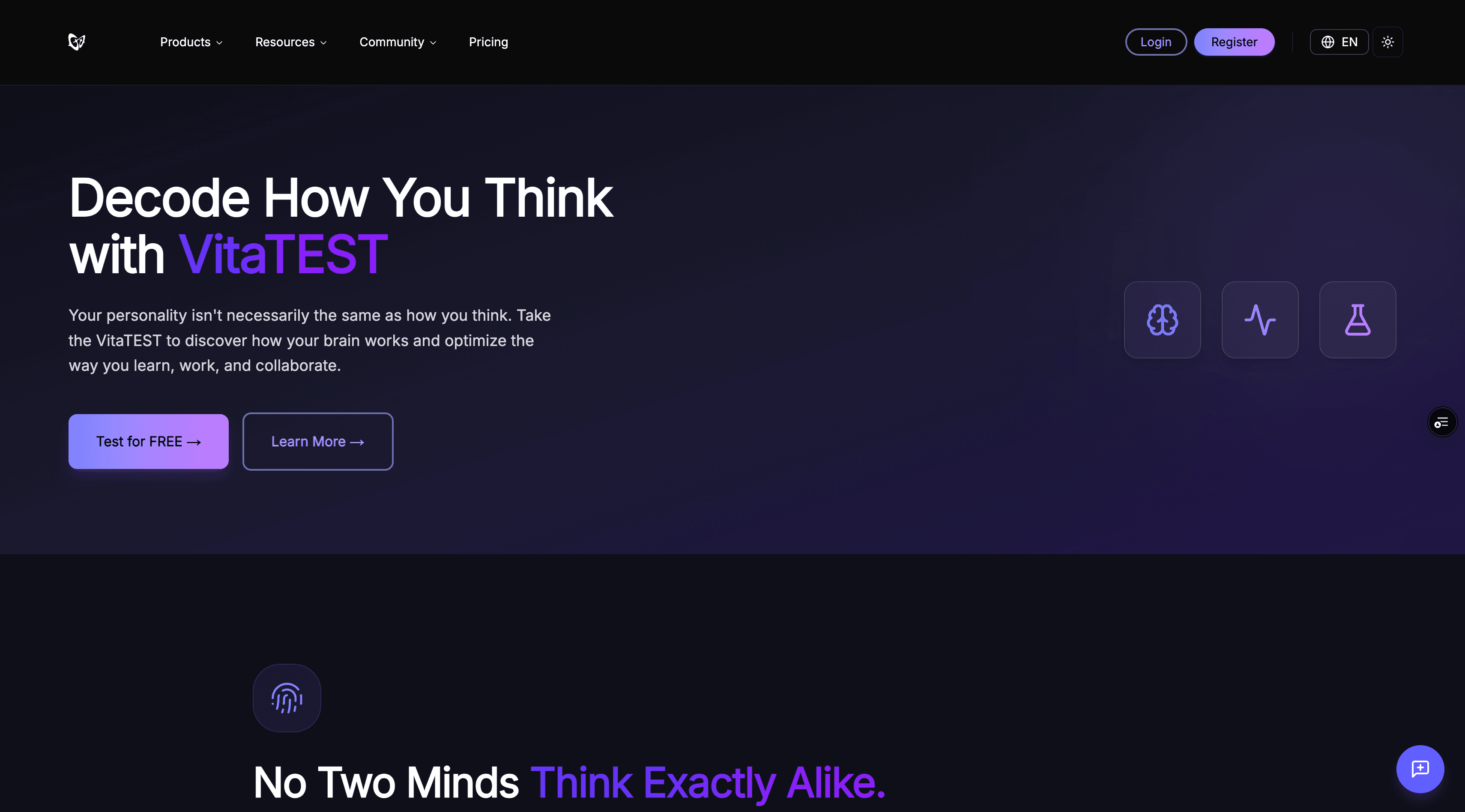
Overview
Vitademy is an online assessment platform designed to help people better understand how they learn and think. Users complete structured assessments, receive insights based on their responses, and get personalized learning recommendations tailored to their individual patterns.
The Problem
Learning is highly individual, but people are often given the same learning methods regardless of how they process information. Vitademy was built to make assessment results easier to understand and turn them into practical, personalized recommendations instead of leaving users with raw scores or generic feedback.
Constraints & Requirements
- Present assessment questions and results in a way that feels simple and approachable despite the complexity behind the evaluation.
- Maintain a clear and responsive user experience across mobile, tablet, and desktop devices.
- Structure assessment data and user responses so they can be reliably stored, processed, and used to generate personalized results.
The Approach
I built Vitademy as a full-stack Next.js application, using TypeScript to keep the application logic predictable and maintainable, Tailwind CSS for the responsive interface, and PostgreSQL for persistent assessment data. I focused on breaking the assessment experience into clear steps so users could move through the process without being overwhelmed, while keeping the underlying components and data flow reusable as the platform grows.
Key Decisions
- Structured the assessment experience as a step-by-step flow to reduce cognitive load and make progress easy to understand.
- Separated assessment content, user responses, and result data so the system could evolve without tightly coupling the interface to the underlying data structure.
- Designed reusable UI components for questions, navigation, progress states, and results to keep the experience consistent throughout the application.
- Used PostgreSQL for persistent structured data, providing a foundation for storing assessments, responses, and future platform features.
The Outcome
The result is a responsive assessment platform that guides users from answering questions to understanding their learning and thinking patterns through a clear, structured experience. The project also established a foundation that can support additional assessments, richer recommendations, and future learning features.
Lessons Learned
- I learned that assessment-heavy interfaces benefit from progressive disclosure — showing users only the information and actions they need at each stage instead of presenting everything at once.
- I gained more experience designing application state and data structures around multi-step user flows, where responses from earlier steps need to remain consistent and accessible throughout the experience.
- I learned to think beyond individual pages and design reusable components and data models that can support additional assessment types as the product grows.
- If I were expanding the project further, I would continue separating assessment logic from presentation so new assessment formats and recommendation strategies could be introduced with minimal changes to the UI.