Velora Pack Internal Dashboard
A role-based internal dashboard for managing customers, leads, inquiries, and orders across the business.
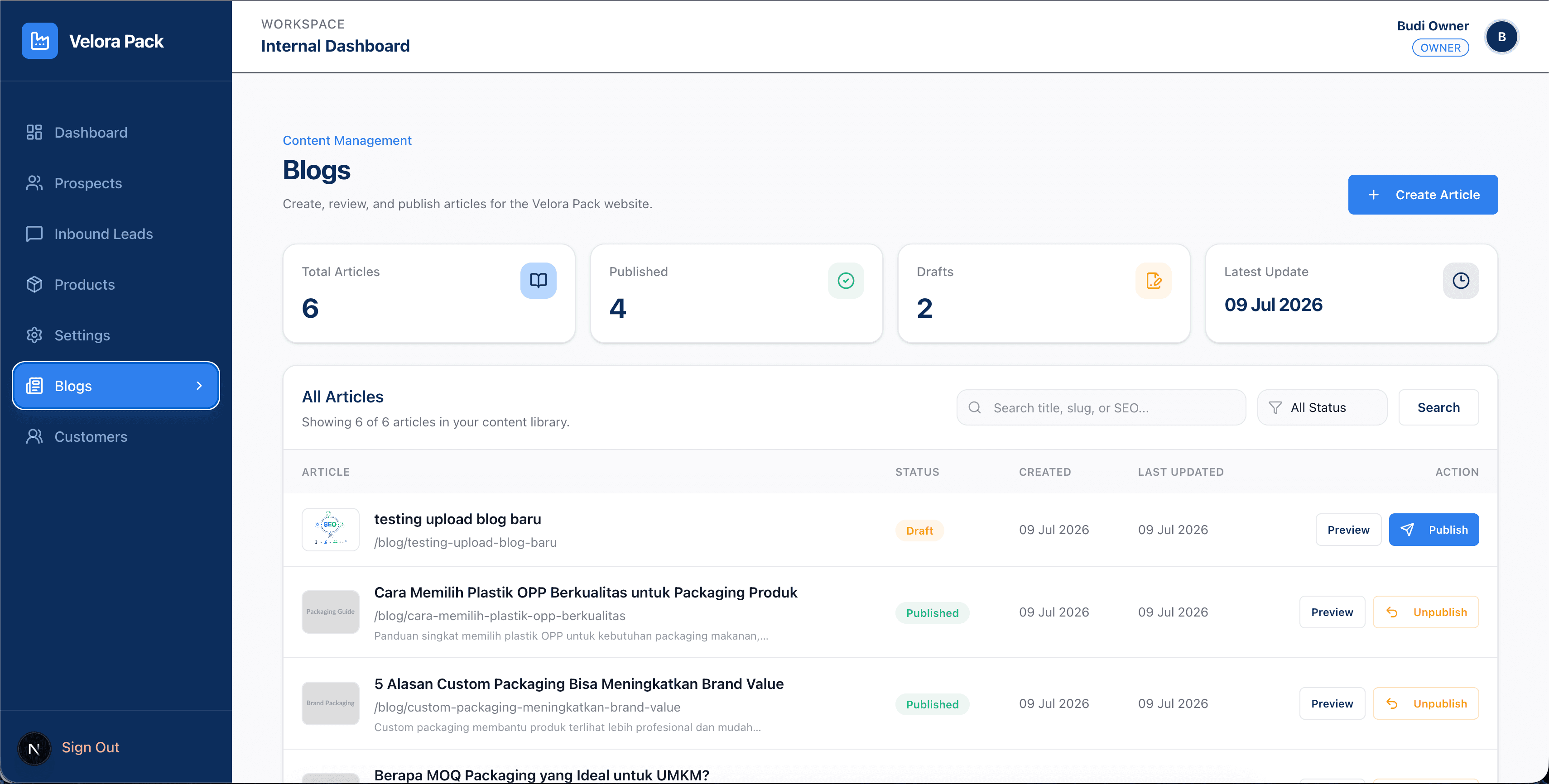
Overview
Velora Pack Internal Dashboard is an internal business application built to help the owner, admin, and sales team manage day-to-day operations from a centralized system. The dashboard brings together customer data, leads, inquiries, and orders so each role can access the information and workflows relevant to their responsibilities.
The Problem
As business operations grow, managing customers, leads, inquiries, and orders across separate tools or manual processes can make information harder to track and workflows less consistent. The dashboard was built to centralize these activities, give each team member clearer visibility into their work, and reduce the friction of managing operational data across the business.
Constraints & Requirements
- Different user roles needed access to different parts of the system based on their responsibilities.
- The dashboard had to support multiple connected business workflows without making the interface difficult to understand.
- Business data needed to remain structured and consistent across customers, leads, inquiries, and orders.
- The interface needed to remain usable across different screen sizes while prioritizing desktop workflows for internal users.
The Approach
I designed the dashboard around Velora Pack’s internal workflows rather than treating it as a generic admin panel. Using Next.js, TypeScript, Tailwind CSS, and PostgreSQL, I structured the application into clear business domains such as customers, leads, inquiries, and orders. I also designed role-based experiences so owners, admins, and sales users could focus on the information and actions relevant to them without exposing unnecessary functionality.
Key Decisions
- Implemented role-based access patterns so owners, admins, and sales users could interact with the system according to their responsibilities.
- Separated customers, leads, inquiries, and orders into distinct but connected data domains to keep business logic easier to understand and maintain.
- Designed reusable dashboard components for tables, forms, status indicators, filters, and common actions to keep workflows consistent across modules.
- Used PostgreSQL to maintain structured relationships between operational data and provide a reliable foundation for future reporting and automation.
- Prioritized clear workflows and information hierarchy over adding unnecessary dashboard complexity or visual features.
The Outcome
The result is a centralized internal system that gives the Velora Pack team a clearer way to manage customer relationships and operational workflows. Owners, admins, and sales users can work from the same source of business data while still having role-appropriate access to the tools they need.
Lessons Learned
- I learned that internal tools need to reflect real business workflows closely; a technically clean interface is not useful if it does not match how the team actually works.
- I gained more experience designing role-based systems where authorization affects both the data a user can access and the actions available in the interface.
- This project strengthened my understanding of relational data modeling across connected business entities such as customers, leads, inquiries, and orders.
- I learned the importance of creating reusable patterns for tables, forms, filters, and status management when building dashboards with multiple operational modules.
- If I were expanding the system further, I would focus on reporting, audit history, notifications, and workflow automation to give the business better visibility into its operations.